
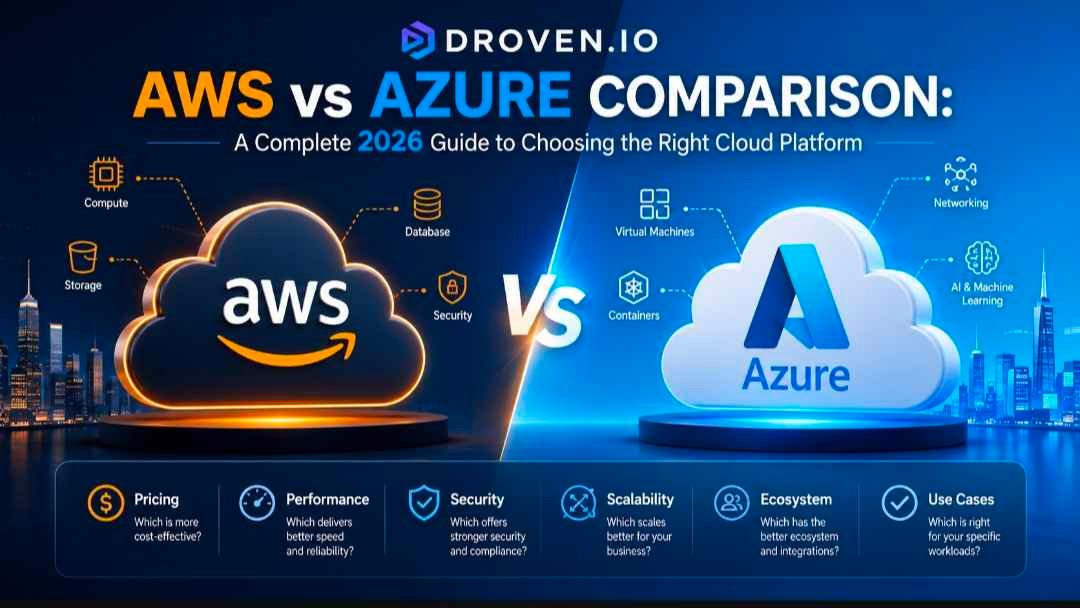
droven io aws vs azure comparison: A Complete 2026 Guide to Choosing the Right Cloud Platform
Cloud computing has become the backbone of modern businesses, helping organizations store data, build applications, and scale operations with ease. When businesses evaluate cloud platforms, Amazon Web Services (AWS) and Microsoft Azure are usually the top contenders. This droven io aws vs azure comparison explores their latest features, pricing approach, performance, security, and ideal use cases to help you make an informed decision.
Whether you’re a startup owner, IT manager, developer, or enterprise decision-maker, understanding the strengths of each platform can save both time and money. While both cloud providers offer hundreds of services, the best choice depends on your business goals, existing technology stack, and future growth plans.
Understanding AWS and Microsoft Azure
Amazon Web Services is the world’s largest cloud computing platform, offering a wide range of Infrastructure as a Service (IaaS), Platform as a Service (PaaS), and serverless computing solutions. It is widely recognized for its mature ecosystem, global availability, and extensive service catalog.
Microsoft Azure is Microsoft’s cloud platform designed to integrate smoothly with Windows environments, Microsoft 365, Active Directory, and enterprise software. It has become a preferred choice for organizations already using Microsoft technologies.
AWS Strengths
AWS offers excellent scalability, a massive global infrastructure, advanced artificial intelligence services, machine learning tools, data analytics, storage solutions, and flexible deployment options. Developers appreciate its extensive documentation and broad community support.
Azure Strengths
Azure stands out for hybrid cloud capabilities, seamless Microsoft integration, enterprise security, and simplified management for businesses that already rely on Windows Server, SQL Server, and Microsoft applications.
Performance, Global Infrastructure, and Scalability
One of the biggest factors in any cloud decision is performance. Both AWS and Azure maintain data centers across multiple regions worldwide, helping businesses deliver fast services to users regardless of location.
In this droven io aws vs azure comparison, AWS often provides more service availability across regions and supports an extensive ecosystem for large-scale applications. Its global infrastructure enables businesses to deploy workloads closer to customers, reducing latency.
Azure performs exceptionally well for organizations that need hybrid cloud environments. Companies can easily combine on-premises infrastructure with cloud resources, making migration smoother and minimizing disruption.
Both platforms automatically scale computing resources according to workload demands, ensuring high availability and business continuity.
Pricing, Security, and Compliance
Cloud pricing can vary depending on storage, networking, computing resources, and additional managed services.
AWS follows a flexible pay-as-you-go pricing model with Reserved Instances, Savings Plans, and Spot Instances for organizations looking to reduce costs over time.
Azure also uses consumption-based pricing while offering cost optimization options for businesses with existing Microsoft licenses. Organizations using Windows Server or SQL Server often benefit from Microsoft’s licensing advantages.
Security and Compliance
Security remains a top priority for both providers. AWS and Azure use advanced encryption, identity management, multi-factor authentication, continuous monitoring, and automated threat detection to protect customer data.
They also comply with major international security standards, making them suitable for industries such as finance, healthcare, education, retail, and government services.
Businesses should remember that cloud security follows a shared responsibility model, meaning providers secure the infrastructure while customers remain responsible for protecting their applications and data.
Developer Experience, AI Services, and Business Applications
Cloud platforms have evolved beyond simple storage solutions. Today they power artificial intelligence, machine learning, big data analytics, containerized applications, and serverless computing.
In this droven io aws vs azure comparison, AWS offers a larger collection of cloud-native services for developers building modern applications. It supports Kubernetes, Docker containers, Lambda functions, analytics platforms, IoT services, and extensive AI capabilities.
Azure has made significant progress in artificial intelligence by integrating AI tools with Microsoft products. Businesses can use Azure AI services alongside Microsoft Copilot, Power Platform, Dynamics 365, and enterprise productivity applications.
Developers working in .NET environments often find Azure easier to manage, while teams building multi-platform cloud-native applications frequently choose AWS because of its mature ecosystem and wider service portfolio.
Both providers continue investing heavily in automation, intelligent monitoring, and cloud optimization technologies.
Which Cloud Platform Is Best for Your Business?
Selecting the right cloud platform depends more on business requirements than on popularity.
This droven io aws vs azure comparison shows that AWS is often ideal for technology startups, SaaS companies, digital businesses, media platforms, and organizations requiring maximum flexibility and a broad range of cloud services.
Azure is an excellent choice for enterprises already invested in Microsoft’s ecosystem. Businesses using Windows Server, Active Directory, Microsoft 365, SQL Server, and enterprise collaboration tools can simplify management by adopting Azure.
Before making a final decision, evaluate several important factors:
- Existing software infrastructure
- Budget and long-term cloud costs
- Security and compliance requirements
- Geographic availability
- Disaster recovery planning
- AI and machine learning needs
- Technical expertise of your IT team
- Future scalability goals
Many large organizations also adopt a multi-cloud strategy, combining AWS and Azure to improve resilience, reduce vendor dependency, and optimize workloads based on specific business requirements.
Frequently Asked Questions
Q. What is the main difference between AWS and Azure?
- AWS offers the largest cloud ecosystem with extensive services, while Azure focuses on seamless Microsoft integration and hybrid cloud environments.
Q. Which platform is cheaper?
- Pricing depends on workload, storage, networking, and licensing. Existing Microsoft customers may save money with Azure, while AWS provides multiple flexible pricing options.
Q. Is AWS more popular than Azure?
- AWS continues to lead the global cloud market, although Azure has experienced rapid growth among enterprise organizations.
Q. Which cloud platform is better for beginners?
- Azure is often easier for users already familiar with Microsoft technologies, whereas AWS provides broader learning resources and certifications for cloud professionals.
Q. Can businesses use both AWS and Azure?
- Yes. Many organizations implement multi-cloud strategies to improve flexibility, reliability, and business continuity.
Conclusion:
Choosing between AWS and Azure is not about finding a universal winner—it is about selecting the platform that aligns with your organization’s objectives. As highlighted throughout this droven io aws vs azure comparison, AWS excels in service variety, global infrastructure, and cloud-native innovation, while Azure shines through enterprise integration, hybrid cloud capabilities, and Microsoft ecosystem compatibility.
Before investing in any cloud platform, assess your business needs, projected growth, technical expertise, and long-term operational costs. With a clear cloud strategy, either AWS or Azure can provide the performance, security, and scalability needed to support digital transformation in 2026 and beyond.